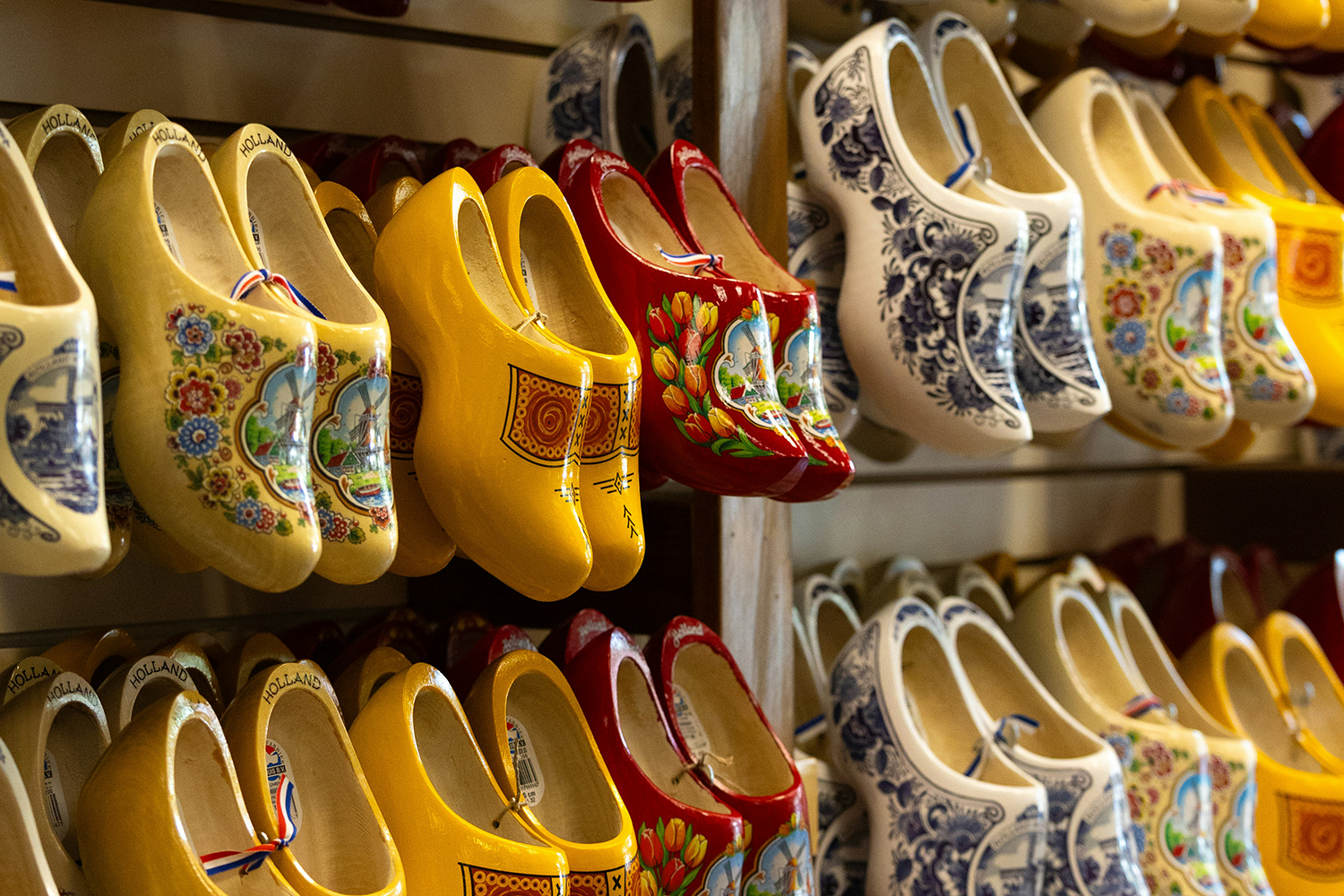
When you think of the Netherlands, wooden shoes might well be one of the first things to come to mind – rather than wood shoes, as you might expect it to be following basic rules of grammar. This extra -en occurs in Dutch too, and it does so even more often than it does in English. But why? And how do you use it? Let’s talk about the stoffelijk bijvoeglijk naamwoord, or the material adjective in Dutch.
Dutch and English are very close relatives, so it makes sense that a few rules here and there exist in both languages. This is also the case for the -en suffix in material adjectives. English, however, doesn’t use it a whole lot. In Dutch, it’s almost always there when materials are used as an adjective.
Dutch vs. English
In fact, this habit was already present in ancient Proto-Germanic languages, well before Dutch and English split up. It also occurred in German – another direct sibling – but there, it has mostly vanished.
The example in the intro of this post, wooden shoes, is one of the most famous ones, especially when you’re talking about Dutch things. Some other notable examples:
the golden ratio
woolen/woollen gloves
a silken dress
The rules in English are a tad ambiguous, to say the least – why is it sometimes golden, but never silveren? In Dutch, thankfully, they are much clearer: almost every substance that is used as an adjective gets this added suffix:
een gouden ring (a gold(en) ring)
de zilveren lepel (the silver spoon)
mijn houten huis (my wood(en) house)
glazen muiltjes (little glass slippers)
het stenen bruidsbed (the stone bridal bed, a famous novel by Harry Mulisch)
een betonnen vloer (a concrete floor)
The only exceptions to this rule are substances that arrived in our language much more recently, often from English:
een plastic tas (a plastic bag, although plastieken is used in Belgium)
een polyester draad (a polyester thread)
een nylon nachtgewaad (a nylon nightgown)
Compound words
Now, if you’ve read the post about Dutch compound words (if not: I strongly suggest you do), you know those are always, by definition, written as a single word. This can also happen when materials are used, although it doesn’t work for just every possible combination. Either way, when this is the case, the -en suffix disappears:
staalkabel (steel cable)
houtwerk (woodwork)
betonvloer (concrete floor)
In these examples, the materials aren’t used as adjectives anymore, they merely form the descriptive part of the compound, and therefore lose the -en. This is no different from English, although you guys do often separate your compounds.
Fun fact
Stoffelijk bijvoeglijk naamwoord pretty much literally means material adjective, but the stof part is an interesting story in and of itself. It shares an old Germanic origin with the English word stuff, as in: a bunch of things (pack your stuff! / ahh, that’s the good stuff). Nowadays, we use the word for material, or substance, and you can see how the two meanings are related.
We still use it quite a lot in words like grondstof (raw/base material, literally: ground material), brandstof (fuel, literally: firing material) and kleurstof (dye/pigment, literally: coloring substance).
Longen story short (nah kidding)
Things are usually made of stuff. Stuff is usually a material. When this material is used as an adjective, in Dutch, and sometimes in English too, -en is added as a suffix. While in English and German, this isn’t as common anymore as it once was, in Dutch, this is still the default, and only some recent additions to our language are exceptions to the rule.
Whenever you use any older-ish substance as an adjective, though, you can bet -en is the way to go – just like in a slightly harsh, but still pretty cool Dutch expression: Al draagt een aap een gouden ring, het is en blijft een lelijk ding (Even when a monkey is wearing a gold(en) ring, it will always be an ugly creature nonetheless).